Wedding photographer? Guest photos are on your side
Guests’ phones are not your competition. What each side captures, how to build guest photos into your packages, and what you really gain from it.
Are you a wedding professional?
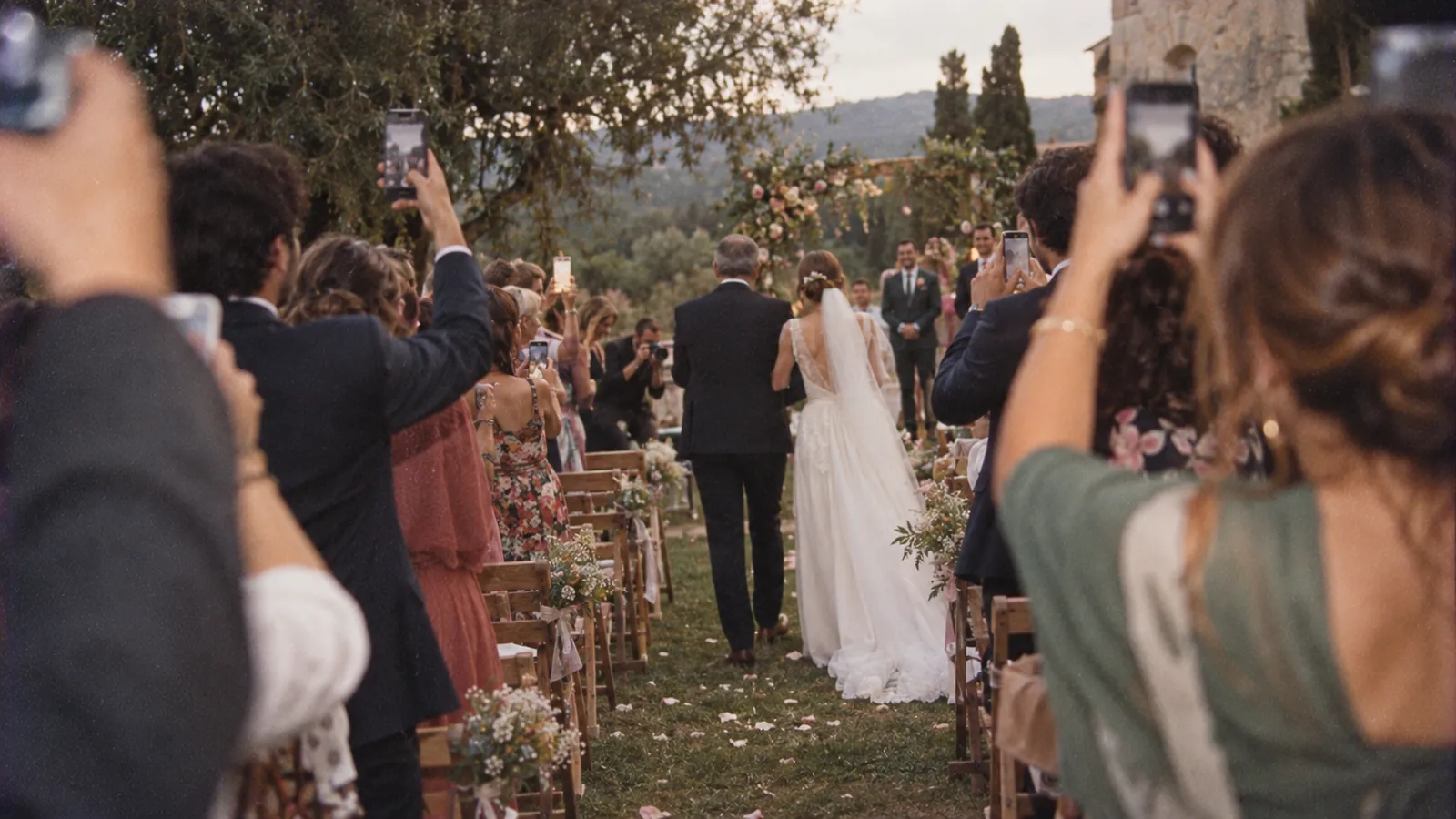
Get listed and receive a free code to introduce Time to Flash to your couples.If you photograph weddings, you know the scene: the bride walks in, and a row of outstretched arms and raised phones appears between you and the aisle. It is tempting to conclude that guest photos have become your competition. The opposite is true. With the right framework, they become a selling point, a service to your couples, and a source of behind-the-scenes images for your own marketing. This article explains why, and above all how to build them into your offer without compromising the quality of your work.
Wedding photographer and guest photos: why it is not a competition
Start with what your couples are buying when they book you. Not “photos”: they will have hundreds of those anyway. They are buying an eye, a command of light, the certainty that the ring exchange will be sharp, portraits that flatter them, group shots organised without losing an hour, and a coherent story from the first to the last moment. No phone delivers that. No guest does either, even one carrying a €3,000 camera, because they are there to celebrate, not to work.
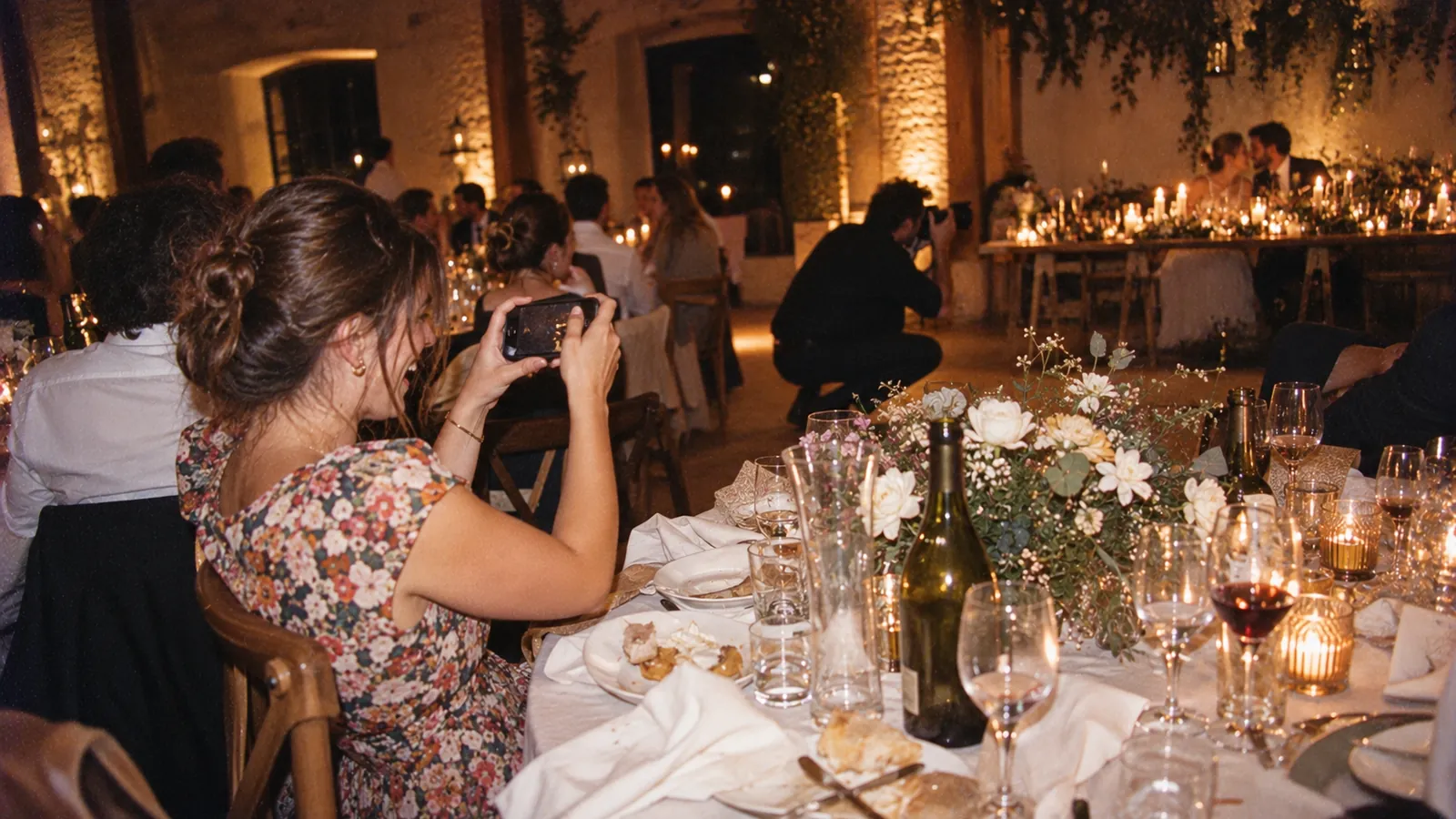
What guests capture is of a different nature: closeness. They are at the back table when the best man fluffs his joke. They are in the groom’s room while he gets ready, which you may not cover. They are on the dance floor at 2 a.m., long after your coverage has ended. Their pictures are often blurry, badly framed, badly exposed; yet they carry something yours do not: they were taken by someone the couple loves, from inside the party.
The two stories do not overlap. They answer each other. And couples know it: nobody asks them to choose between a photographer and their friends’ photos. They want both.
What each side captures
To talk about it clearly with clients, the simplest thing is to lay out the split in black and white.
| Moment | The photographer | The guests |
|---|---|---|
| Getting ready | Details, the dress, light, the parents’ emotion | The other side of the story (the groom’s room, the car ride) |
| Ceremony | Everything: entrance, rings, exit | Nothing, ideally (unplugged ceremony) |
| Group photos | Organisation, posing, sharpness | Nothing: this is where they get in the way most |
| Couple portraits | You alone, at golden hour | What happens at the drinks reception meanwhile |
| Dinner | Speeches, entrances, reactions | The tables, the laughter, the grandparents |
| First dance | The reference shot | The faces of the guests watching |
| Late party | Often outside the package | The dance floor, the improvised photo corner, the after-party |
You can show this table as it is in a client meeting. It says one simple thing: you cover the moments that matter; the guests cover the moments nobody can cover. There are only two real overlaps, the ceremony and the group photos, and those are exactly the two places where phones should be put away.
The real problem: chaos, not photos
When photographers complain about guests, it is almost never because they take photos. It is because they take them anywhere, anyhow:
- the aunt who plants herself in the aisle as the bride walks in;
- the uncle who stands right behind you during group shots, so half the family looks at his lens instead of yours;
- the tablet held above everyone’s heads during the ring exchange;
- a phone flash going off at the exact moment you press the shutter.
These are framework problems, not matters of principle. They are solved with two levers: an unplugged ceremony (phones away during the vows) and a clear framework for the rest of the day. We cover every technique, with wording to copy, in our guide to handling guests on their phones.
The second lever deserves a closer look, because it is where guest photos turn from nuisance into ally. A guest told “not allowed” complies for twenty minutes, then takes their phone out again. A guest given a game, with rules, plays along all evening.
The disposable camera principle
Remember the disposable cameras left on wedding tables in the 1990s and 2000s. Twenty-seven shots, no screen, photos discovered once developed. Nobody fired away, nobody checked their framing, nobody spent the evening staring at a screen. The idea is back on phones, with apps that use the same rules:
- a limited number of shots per guest: people do not raise their phone every second, they pick their moments;
- photos hidden until the reveal: no “check, retake, post to my story” reflex;
- a shared reveal, often the next day, when everyone discovers the album at the same time.
For you, the effect is concrete: fewer phones permanently in the air, fewer guests stepping in to “get the same shot as the photographer”, fewer stray flashes. A shot limit is the antidote to the wall of phones.
This is what Time to Flash, the service we make, does: each guest scans a QR code (no app to install), gets 3 to 15 shots depending on the couple’s setting, and the album is revealed all at once. But the principle matters more than the tool: whatever you recommend, look for the shot limit and the delayed reveal. A simple gallery where everyone uploads their photos changes nothing about how guests behave during the party.
Why your couples want both
Listen to what couples say after their wedding and four reasons keep coming up.
1. They want to see their wedding through their guests’ eyes
On the day, couples live a very partial version of their own party. They are swept up in congratulations, photos, the schedule. They do not see table 8 crying with laughter, or their grandmother getting up to dance. Your coverage gives them the day as it looked at its most beautiful; the guests’ photos give them the day as it was lived around them. Not the same thing, and both are precious. We explain it from the couple’s side in your guests see what the photographer can’t.
2. The party goes on after you leave
Most packages end after the first dance or the first hours of the evening. The dance floor, meanwhile, lives until the end of the night. Nobody expects you to stay until 5 a.m.; the guests are there anyway.
3. A photo’s emotion also comes from who took it
A slightly blurry photo taken by the best friend carries a particular emotional weight. “Julien took that one” is part of the memory. Guest photos give couples a choral album, alongside yours.
4. They don’t want to wait
Your gallery usually arrives several weeks after the wedding, and rightly so: culling and editing take time. Meanwhile, couples want to relive their party. The guest album, revealed the next day, fills that gap. More on what that changes for you below, and in detail in wedding photo delivery times.
How to build guest photos into your offer
There are three ways to do it, from the lightest to the most committed. None requires changing how you work on the day.
Level 1: free advice
You recommend a guest photo activity in your planning questionnaire or client meeting, and the couple sets it up themselves. Cost to you: nothing. Benefit: you position yourself as an adviser who thinks about the whole day, not just your hours behind the camera. It is also the moment to set your conditions: “Guest photos, absolutely, but from dinner onwards; during the ceremony, we ask everyone to put their phones away.”
Level 2: included in your premium package
You include the activity in your top package, alongside the second shooter, the engagement shoot or the printed album. The cost of a QR code activity is modest at the scale of a wedding package: at Time to Flash, for instance, it is a one-off €29.99 for up to 100 guests and €34.99 for up to 150 (October 2026 prices). What you are selling is not a technical line item, it is a promise: “Your wedding told from two points of view: mine, and your guests’.”
That line has a rare advantage: it sets you apart without cutting your prices. When two photographers of similar level are competing, a detail like this often tips the balance, because it shows you thought of something the other did not mention.
Level 3: an add-on
You offer the activity as an extra, like an additional hour of coverage. It is the easiest option to explain but the least distinctive: an add-on gets compared; a promise built into the package, much less so.
Who creates the album, and who manages it?
Two set-ups work. Either you create the event yourself and invite the couple as co-hosts: they see the photos before the reveal, can hide any that are awkward, and set the reveal time. Or the couple creates it and adds you as a co-host if you want to follow along. Either way, remember one rule: the guest album belongs to the couple. You do not edit it, you do not deliver it, and it is not part of your photography service. Put that in your contract to avoid any confusion about expected quality.
A line ready for your brochure
If you need wording for your website or pricing guide, here is one to adapt:
“Included in the Signature collection: the guests’ disposable camera. Each of your loved ones scans a QR code and gets a few shots to use during the evening. The photos stay hidden until the next day, then appear all at once. My coverage tells the story of your wedding; theirs tells the story of the party from the inside.”
What you actually gain
Beyond the sales argument, guest photos do you some very concrete favours.
Fewer impossible requests
You know them: “Do you have a photo of Uncle Gerald at table 8?”, “My colleagues aren’t in the gallery”, “My cousin says there was an amazing moment during dessert, did you get it?” You cannot be everywhere, and these requests leave a bitter taste for the couple and for you. When a guest album exists, the answer becomes simple: the tables and moments you did not cover are in the guests’ album. You deliver your work without having to justify what you could not see.
Behind-the-scenes material for your marketing
Guest photos often show… you. Crouching in the aisle, standing on a chair for the group shot, making the children laugh. These are golden images for your Instagram or your “about” page: they show how you work, something no portfolio tells. One caution: these photos belong to their authors (the guests) and show identifiable people. Ask the couple, and ideally the author, before publishing anything. The legal side is explained in image rights and wedding photos.
Happy couples sooner, so warmer reviews
When a couple leaves a review matters. Three weeks after the wedding, the emotional high has faded and life has resumed. The day after, they are still carried by the party. If the guest album is revealed that day, the first thing they relive is their wedding seen through their loved ones’ eyes, and they associate that moment with the overall experience you recommended. You can also slip a simple line into your thank-you message: “Enjoy your guests’ album; my gallery arrives in six weeks as agreed.”
A safety net for off-camera moments
While you take the couple away for golden-hour portraits, the drinks reception carries on without you. While you change batteries, someone gives an impromptu speech. Those moments will not be lost, and you need not apologise: capturing them was never your job.
Objections, and how to answer them
“It will devalue my work”
The contrast works in your favour. Guest photos, taken on phones with a few shots and often an openly film-style look (grain, flash, warm colours), look nothing like professional coverage. Nobody confuses a flash shot from the dance floor with your golden-hour portrait. Next to the guest album, your gallery looks even more accomplished.
“Couples will compare”
They already do, with every Instagram story posted that night. The difference is that with a clear framework (photos hidden until the next day), there are fewer live stories, so fewer improvised comparisons during the party, and more images gathered in one place, calmly.
“Guest photo quality is poor”
Yes, and that is not the point. Nobody asks guests to do your job. Their photos are memories, not deliverables. Services of this kind often store images at a size suited to screens and small prints (1600 pixels at Time to Flash): it is a memory album, not an image library.
“Guests will get their phones out even more”
This is the most common fear, and the opposite happens when the rule is well set. A guest who knows they have ten shots for the whole evening does not raise their phone during group photos: they save their shots for the dance floor. A guest who cannot see their photos does not spend ten minutes editing them for a story. The game channels what was already happening, chaotically.
On the day: how to work alongside the activity
Here is the order we recommend, to agree with the couple and the wedding planner if there is one:
- Unplugged ceremony. The officiant asks guests to put phones away during the vows (script to copy in our techniques guide).
- No QR code in the aisle. The code appears on the dinner tables, at the bar, near the dance floor: not at the ceremony entrance.
- An announcement at the start of dinner. The DJ or a best man presents the game: “You each have a few shots; the photos will be revealed tomorrow.”
- Protected group photos. You explain that the guest album is for spontaneous moments and they do not need to duplicate your groups.
- You work as usual. The activity runs by itself, with no booth to watch and no equipment to set up.
- Reveal the next day. The couple and their guests discover the album; your sneak peek can follow right after, and your full gallery on schedule.
If the couple is unsure how to organise it, our copy-and-paste guest brief gives them the messages to send before the wedding.
In short
- Guests do not do your job: they capture what you cannot see.
- The only real conflict is during the ceremony and the group photos: that is where phones go away.
- For the rest, a framework (limited shots, hidden photos) beats a ban.
- Built into your premium package, the activity sets you apart without touching your prices.
- It spares you impossible requests, gives you behind-the-scenes images and fills the wait before your gallery.
Want to offer Time to Flash to your couples? We are preparing a programme for photographers, wedding planners and venues: find out how to offer Time to Flash to your couples.
Frequently asked questions
Do guest photos compete with the wedding photographer?
No. The photographer covers the key moments with a professional eye (ceremony, portraits, groups), while guests capture what the photographer cannot see: the tables, the dance floor late at night, behind the scenes. Couples want both, and the two sets of photos complement each other.
How do you stop guests’ phones getting in the photographer’s way?
Ask for an unplugged ceremony, announced by the officiant, and protect the group photos. For the rest of the day, give a framework rather than a ban: an activity with a limited number of shots and photos hidden until the next day clearly reduces the number of phones in the air.
Can a photographer include a guest photo activity in a package?
Yes. You can recommend it for free, include it in your premium package or offer it as an add-on. A QR code activity costs a few dozen euros at most for a wedding, which makes it an inexpensive way to stand out.
Can the photographer use photos taken by guests?
Only with permission. The photos belong to the guests who took them and show identifiable people. Ask the couple and, ideally, the author before publishing them on your website or social media.
What is an original wedding photography package idea?
Telling the wedding from two points of view: yours and the guests’, with a digital disposable camera revealed the next day. It sets you apart from a photographer of similar level without lowering your prices, and it fills the couple’s wait before your gallery.