Guests on their phones: 17 techniques for wedding photographers
Signs, officiant scripts, positioning, tactful phrases to say on the spot: 17 practical techniques to stop guests’ phones ruining your wedding photos.
Are you a wedding professional?
Get listed and receive a free code to introduce Time to Flash to your couples.Guests on their phones are wedding photographers’ number one irritation: an arm in the aisle as the bride walks in, a tablet above everyone’s heads during the ring exchange, an uncle shooting over your shoulder during group photos. Are there really techniques to prevent it? Yes, and they work best combined. Here are 17, in the order you will use them: before the wedding, during the ceremony, during the party, and when faced with the over-eager guest. Each comes with wording to copy.
One principle runs through all of them: you don’t win against phones, you give them a place. A total ban lasts twenty minutes. A clear framework (away during the ceremony, free but channelled afterwards) lasts all day, and nobody feels punished.
Before the wedding: guests, phones and the photographer, it starts early
Half the work happens before the day. A guest who has been told three times does not need correcting on the spot.
1. Discuss it with the couple at contract stage
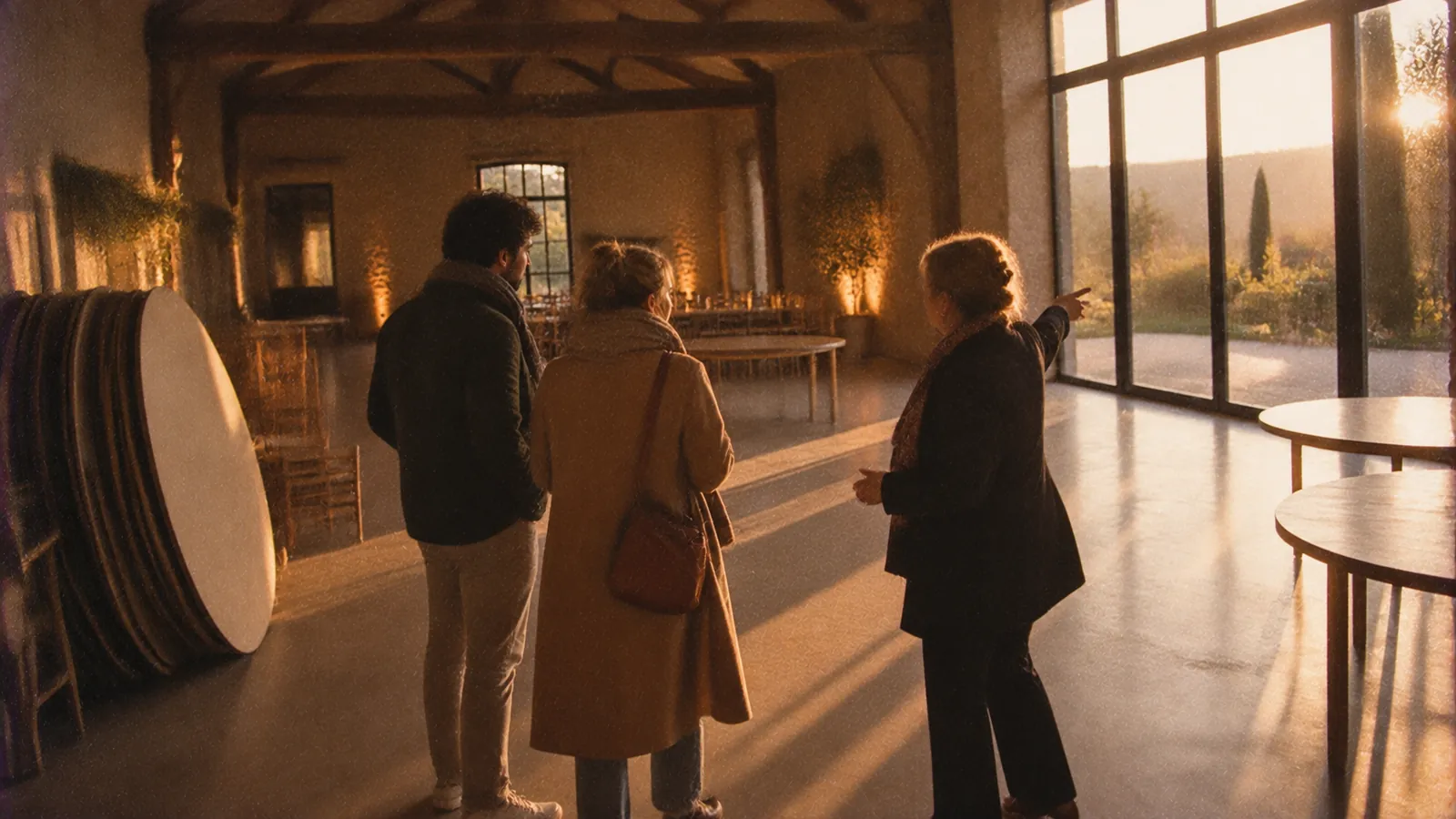
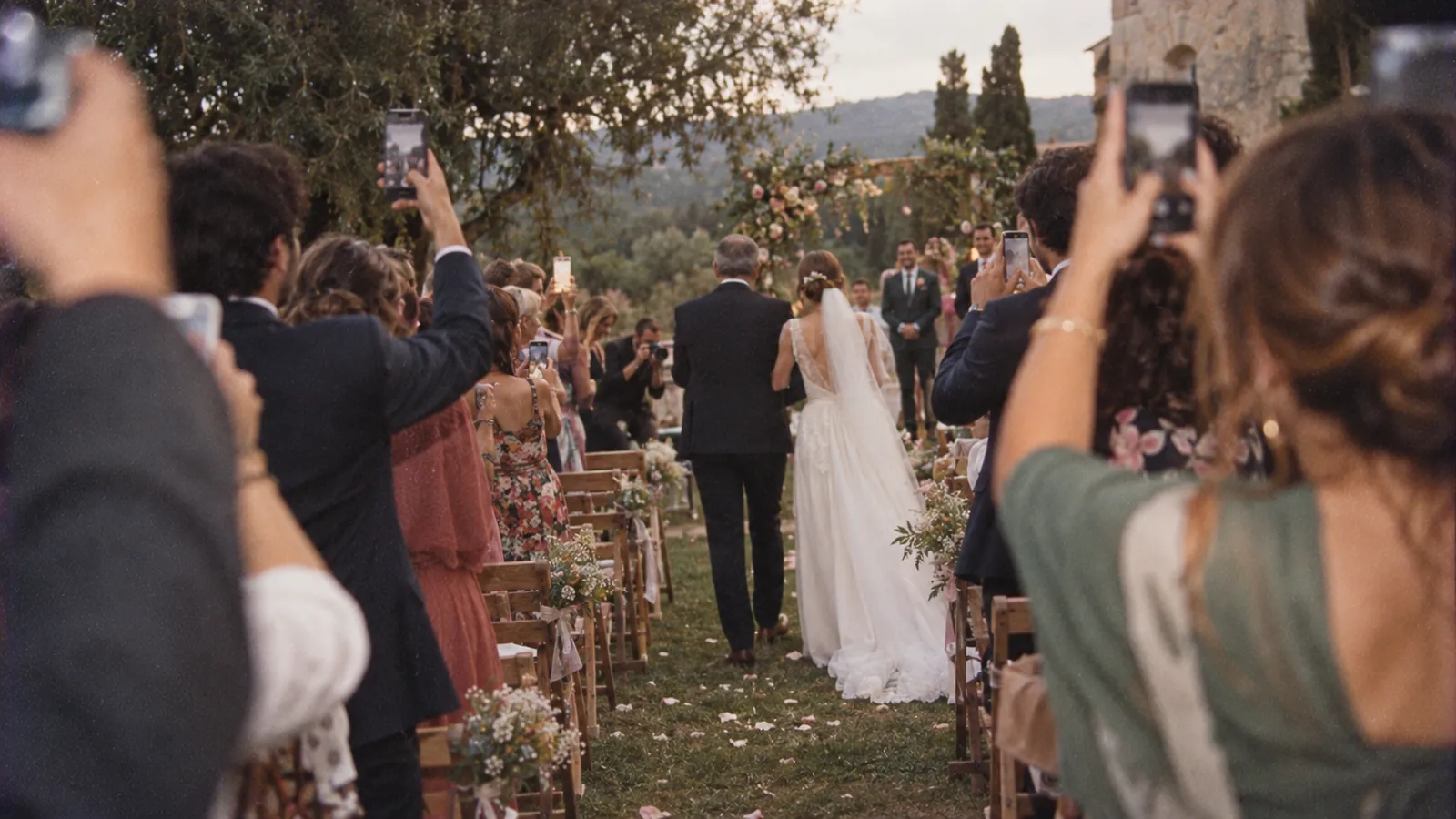
The couple decides, not you. Your job is to explain what is at stake with pictures: show them two ceremony entrances, one with a wall of phones, the other with moved faces. Most couples choose in three seconds.
Then add a line to your contract or planning questionnaire, for example:
“The couple agrees to inform their guests of their wish for an unplugged ceremony. The photographer cannot be held responsible for phones or guests in the frame during key moments.”
Nothing aggressive about it: it protects everyone and opens the conversation.
2. A note on the invitation or wedding website
The invitation is where guests first discover the rules. A few wordings, from the most sober to the lightest:
- “We’d love an unplugged ceremony. Our photographer is taking care of the memories; we just want to see your faces.”
- “During the ceremony, please keep your phones in your pockets: you’ll get all the photos afterwards.”
- “Unplugged ceremony: put away your screens, bring out your tissues.”
If the invitations are already printed, the wedding website or RSVP confirmation will do just as well.
3. The day-before reminder
A message in the guests’ group chat, or an email the day before, covers the practical details (times, parking, dress code) and slips the rule in. That reminder is often the one people remember. Couples will find ready-made messages in our copy-and-paste guest brief.
4. A sign at the ceremony entrance
A sign on an easel where guests take their seats is the most visible technique. It must be readable from a distance, short and friendly. Wording to copy:
- “Welcome to our unplugged ceremony. Please put your phones away: our photographer has it covered.”
- “We invited you to be present, not to film. Please switch off your phones.”
- “Enjoy this moment with your eyes. The photos will come later, we promise.”
- “The only thing we want to see in the aisle is you.”
Suggest the couple place it at eye level, at the start of the aisle rather than the back, and add a small card on the front-row chairs.
5. Appoint a friendly enforcer
You cannot police and photograph at the same time. Ask the couple to name someone who will gently remind people of the rule: the wedding planner if there is one, otherwise a member of the wedding party who gets on with everyone. Brief them in two minutes before the ceremony: where you will stand, which moments are sensitive, and what to say.
6. Schedule the moment when phones are allowed
A ban without compensation creates frustration. Plan with the couple when everyone can take their photo: as the couple walk out, during the confetti, or just after the ceremony. A guest who knows their moment is coming waits much more willingly.
During the ceremony: how to ask guests to put their phones away
7. The officiant’s announcement
By far the most effective technique. A sentence over the microphone, just before the couple enters, from the person who has everyone’s attention. Scripts to copy:
“Before we begin, the couple has one request: they would love you to share this moment with them, not through a screen. Please put away your phones and cameras. Their photographer will capture everything. You’ll have a moment for your own photos at the end.”
Lighter version:
“A quick reminder before the bride walks in: the best gift you can give the couple today is your full attention. Phones in pockets, tissues at the ready.”
In some civil ceremonies (at a registry office or town hall), you cannot always ask the registrar or mayor to make this announcement. In that case, a member of the wedding party can make it in the room just before the official arrives. For a celebrant-led or religious ceremony, the officiant usually agrees happily, as long as they get the script in advance.
8. Your positioning
Good positioning solves part of the problem before it appears:
- Scout the venue, or ask for a floor plan: where the bride enters, where the couple stands, where the light comes from.
- Ask for the aisle to stay clear and for the aisle-end seats not to go to the most enthusiastic guests.
- Get into position before the entrance, at the end of the aisle, and only move between key moments.
- Plan a back-up angle, higher up or to the side: if an arm appears, you change angle without running.
- Work with a second shooter at large ceremonies: one facing, one to the side, and phones cannot block both at once.
9. The permitted photo moment
The staged counterpart of technique 6. After the kiss or at the end of the ceremony, the officiant announces: “And now you may take out your phones: the couple is giving you thirty seconds for your souvenir photo.” The couple turns to face everyone, everyone shoots, people laugh, and the rule is respected without frustration. Take the chance to capture the whole room with phones raised: that image tells a story too.
10. Coordinate with the DJ and musicians
The DJ holds the microphone all day. Brief them on the moments where an announcement helps: the grand entrance, the first dance, the cake. One sentence is enough: “For the first dance, please leave space around the couple and put your phones away for a few minutes: the photographer has it covered.” A briefed DJ does this better than anyone, in the tone of the party.
11. Group photos: one for the phones
During group photos, the problem is not the phone in the aisle but the guest standing behind you: half the group looks at their lens, and your shot is ruined. The technique that works: after each group photo, announce yourself “And now, one for the phones!” and give guests ten seconds. Nobody needs to shadow you any more, since everyone knows their turn is coming. Before you start, one sentence sets the frame: “So everyone looks in the right place, I’ll let you take your photos straight after each of mine.” Our tips for organising groups are in wedding group photos.
During the party: channel rather than ban
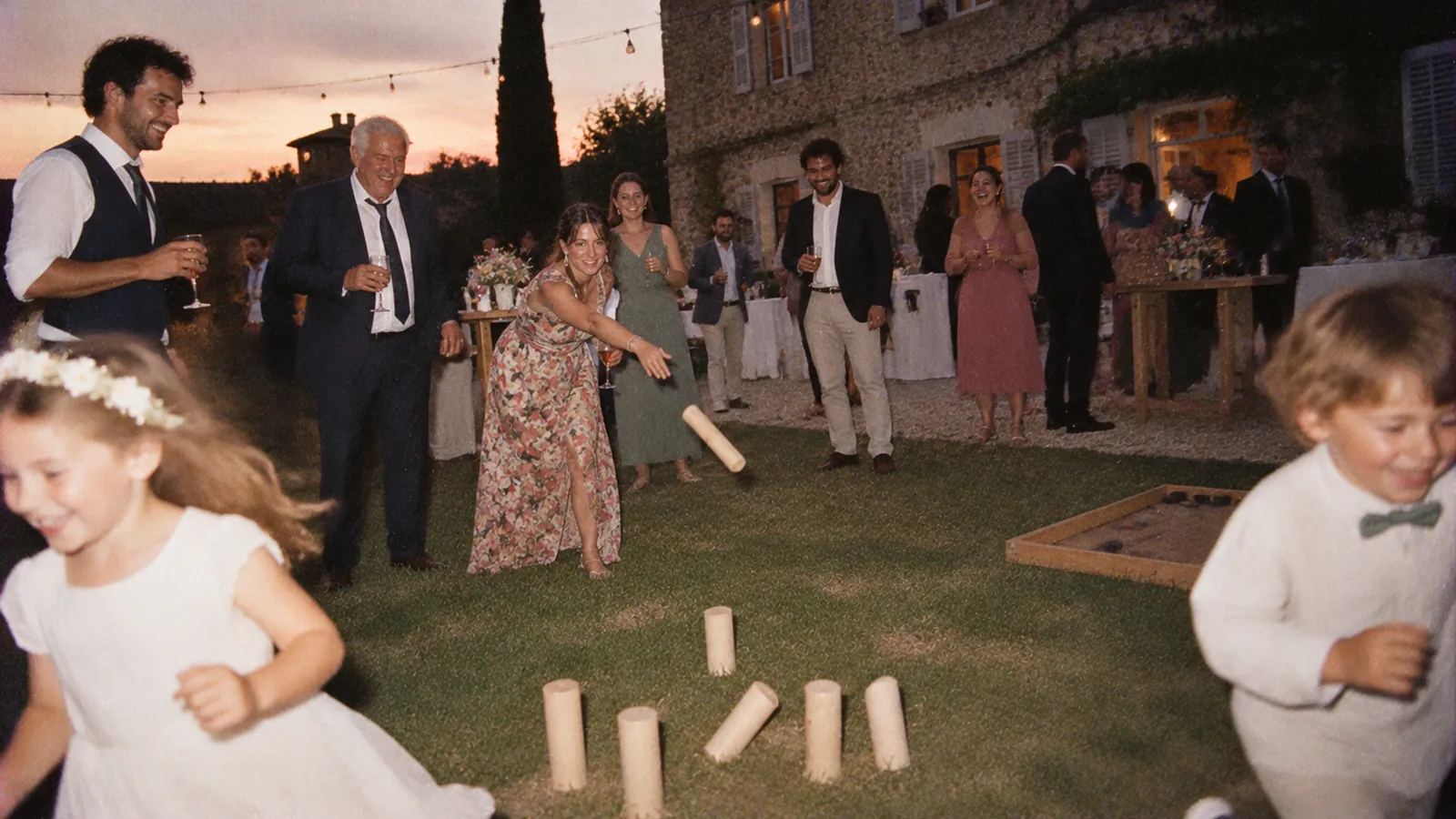
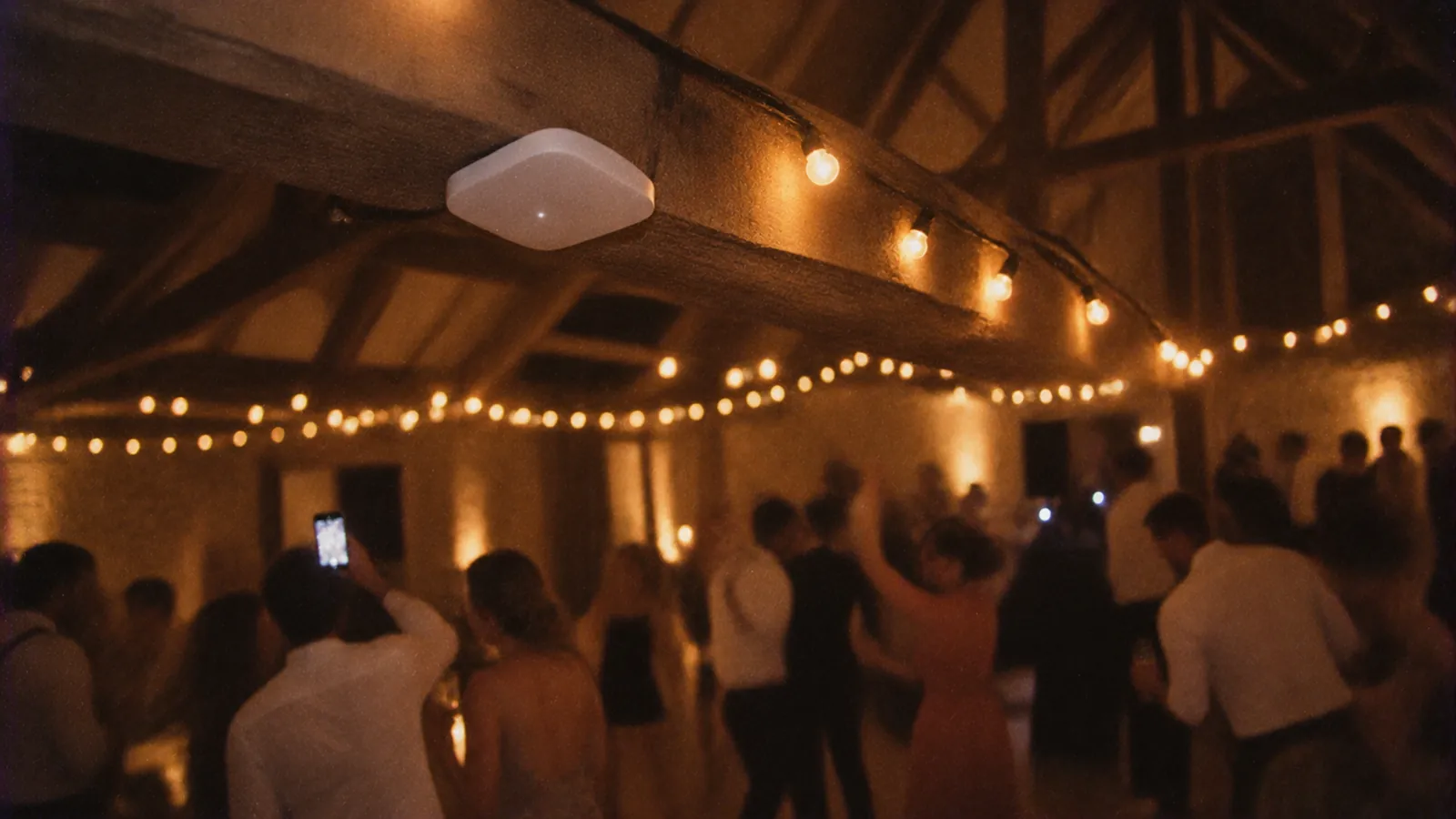
After the ceremony, banning phones no longer makes sense. Guests will take photos, and that is a good thing: they capture the tables, the dance floor, the behind-the-scenes, everything you cannot see. The only issue is making sure they do it without getting in your way and without spending the evening staring at a screen.
12. A disposable camera QR code
The most effective technique for the evening, because it changes guests’ behaviour rather than fighting it. The principle borrows from the disposable cameras once left on tables: each guest scans a QR code, and their phone becomes a camera with a limited number of shots and hidden photos until a shared reveal, often the next day.
What it changes for you:
- Fewer phones constantly in the air. With ten shots for the whole evening, nobody fires away; everyone saves their shots for the moments that count.
- Less “check and retake” reflex. With hidden photos, nobody spends three minutes looking at their screen after each shot.
- Fewer live stories. Photos are discovered together, later, instead of being posted one by one during the party.
- Fewer guests in your frame. Those who used to follow you to “get the same shot” now have their own game.
This is what Time to Flash, the service we make, does: a QR code with no app to install, 3 to 15 shots per guest as the couple chooses, and an album revealed all at once. But whatever tool you recommend, check the two key points: the shot limit and the hidden photos. A simple sharing gallery where everyone uploads their pictures changes nothing about behaviour during the party. We develop this approach in guest photos are on your side.
13. Place the QR code where you are not working
The code should not appear in the ceremony aisle or where group photos happen. Put it on the dinner tables, at the bar, near the cloakroom, next to the dance floor: where guests have time and where your key moments are not at stake. Our tested spots are in where to put the QR code, and couples can make their poster with the free QR code poster generator.
14. Protect the two or three key moments of the evening
First dance, cake cutting, speeches: these moments deserve a short announcement, as at the ceremony. Ask the DJ or the best man hosting to say: “During the first dance, front row phone-free, please. The dance floor is yours right after.” The rest of the time, let it be: the evening belongs to the guests.
15. Phone flashes
A phone flash firing during your exposure can blow out an image. If you use off-camera flash during the first dance, warn the DJ: one sentence asking people to switch off their flash for that song is enough, and most guests comply. For the rest of the evening, it is a lost battle; better to accept it.
The over-eager guest: what to say, on the spot, with tact
Despite everything, there will always be someone. The keen cousin following you with his DSLR, the aunt standing in the aisle, the friend live-streaming the speech. The goal: solve it without creating awkwardness, for them or for the couple.
16. Phrases that work
Always quietly, with a smile, offering an alternative rather than a reproach:
- The guest in the aisle: “Could I ask you to step over one pace? The couple asked me to keep the aisle clear for the entrance. You’ll have a beautiful view from here.”
- The guest behind you during groups: “I’ll hand over to you right after this one, otherwise everyone looks at your phone instead of my camera.”
- The amateur photographer following you: “Great camera! During the ceremony I’ll need all the space, but afterwards I’ll show you the best angles in the venue if you like.” Turning them into an ally almost always works.
- The tablet above the heads: “It’s blocking the view for the whole row behind you. I’ll send you a photo of this moment, promise.” If you promise, keep your word.
- The live stream: not yours to handle. Quietly alert the appointed enforcer (technique 5), who knows whether the couple minds.
17. Delegate, and never make it a drama
If the guest insists, do not confront them: go through the enforcer or the wedding planner. You are a supplier; they are someone close to the couple. A scene would cost you far more than a missed shot. And do not complain to the couple during the party. If a key moment was spoiled, talk about it calmly after the wedding, with a solution (a crop, another frame from the same sequence).
Recap: the 17 techniques at a glance
| When | Technique |
|---|---|
| Before | 1. Discussion and contract clause with the couple |
| Before | 2. Note on the invitation or website |
| Before | 3. Day-before reminder |
| Before | 4. Sign at the ceremony entrance |
| Before | 5. A friendly enforcer |
| Before | 6. A permitted moment in the schedule |
| Ceremony | 7. Officiant’s announcement |
| Ceremony | 8. Photographer positioning |
| Ceremony | 9. The permitted photo moment |
| Ceremony | 10. Coordination with the DJ |
| Ceremony | 11. “One for the phones” after each group |
| Party | 12. Disposable camera QR code (limited shots, hidden photos) |
| Party | 13. QR code away from your working areas |
| Party | 14. Key moments protected by an announcement |
| Party | 15. Flash off during the first dance |
| On the spot | 16. Tactful phrases |
| On the spot | 17. Delegate, no drama |
Should the whole wedding be phone-free?
Some couples want to ban phones all day. That is their right, but you can remind them what they lose: photos of the tables, of the dance floor at 2 a.m., of the behind-the-scenes, which you will not be able to take. The middle ground (unplugged ceremony, channelled party) almost always gives a better result, for them and for you. The debate is covered from the couple’s side in unplugged wedding: good or bad idea?
In short
- Most of the work happens before: contract, invitation, reminder, sign.
- During the ceremony, the officiant’s announcement is the most effective technique; a permitted photo moment prevents frustration.
- During groups, “one for the phones” after each shot solves the guest-behind-you problem.
- During the party, channel instead of banning: a digital disposable camera, with limited shots and hidden photos, curbs the urge to check and repost.
- With the over-eager guest: quiet voice, smile, an alternative, and an enforcer if that is not enough.
Want to offer this digital disposable camera to your couples, to stay in control of phones on the day? We are preparing a programme for photographers: find out how to offer Time to Flash to your couples.
Frequently asked questions
How do you ask guests to put their phones away during the ceremony?
Combine several reminders: a note on the invitation, a message the day before, a sign at the entrance and above all an announcement by the officiant just before the couple enters. Planning a moment when phones are allowed, at the exit for example, makes the request far more acceptable.
What is an unplugged ceremony?
A ceremony where the couple asks guests not to use their phones or cameras. The photographer has a clear view, and the couple sees faces rather than screens. Most couples limit the rule to the ceremony and let phones back in afterwards.
What should a photographer do if a guest gets in the way?
Speak to them quietly, with a smile, and offer an alternative: step over a pace, wait for the next shot, or take their photo right after. If the guest insists, go through the wedding planner or an appointed member of the wedding party, and never confront someone close to the couple.
Should phones be banned for the whole wedding?
Usually not. During the party, guests capture the tables, the dance floor and the behind-the-scenes, which the photographer cannot cover. Better to channel them, for example with a digital disposable camera with limited shots and photos hidden until the next day.
What should an unplugged ceremony sign say?
A short, friendly sentence readable from a distance, for example: “Welcome to our unplugged ceremony. Please put your phones away: our photographer has it covered.” or “Enjoy this moment with your eyes; the photos will come later.”