Wedding planner services: 12 add-ons that set you apart
The three classic wedding planner packages, then 12 add-on services to build into your offer: what couples gain, your margin, and how to sell each one.
Are you a wedding professional?
Get listed and receive a free code to introduce Time to Flash to your couples.Wedding planner services often fit on three lines of a brochure: full planning, partial planning, day-of coordination. Couples compare those three lines from one planner to the next, and the conversation quickly turns to price. To get out of that comparison, you need an offer that doesn’t look like everyone else’s.
This guide covers the core packages (what goes in them, how to scope them), then walks through 12 add-on services you can build into your offer. For each one: what the couple gains, the effort or margin it represents for you, and how to present it without it feeling like padding.
Wedding planner services: the three core packages
Almost every planner builds their offer around the same three packages. The names vary; the contents much less so.
Full planning
You run the project from start to finish, often 12 to 18 months before the date: budget, venue search, vendor selection and negotiation, contracts and payment schedules, design direction, planning timeline, guest management, then coordination on the day. It is the most profitable package per wedding, and also the one that eats the most hours: dozens of meetings, site visits and email threads.
Partial planning
The couple has already made progress (usually the venue and caterer are booked) and hands you the rest: a few vendors to find, the decor, the schedule, the coordination. This is the package where scope creeps most easily. Write down, in the quote, exactly which vendors you take on and how many meetings are included.
Day-of coordination
The name is misleading: nobody coordinates a wedding well if they discover it that morning. In practice you start one to three months before: review every contract, call every vendor, do a technical walkthrough of the venue, build the run of show, then stay from morning to evening. It is often the entry point for couples who planned to “do it all themselves” and realise, two months out, that they don’t want to spend the day managing the caterer.
| Package | You start | What you handle | Typical range in France |
|---|---|---|---|
| Full planning | 12 to 18 months out | Everything, from budget to the day | Roughly €3,000 to €6,000, far more at the high end |
| Partial planning | 4 to 9 months out | Some vendors, decor, schedule, the day | Roughly €1,500 to €3,500 |
| Day-of coordination | 1 to 3 months out | File review, run of show, presence on the day | Roughly €900 to €2,500 |
These ranges come from rates published by French planners and specialist guides in 2026. They vary a lot by region, experience, country and guest count: treat them as orders of magnitude, not a price list.
Flat fee or percentage? Some planners charge a percentage of the total budget (10 to 15% is often quoted), but most use a flat fee. A flat fee reassures couples (they know what they are paying) and spares you the suspicion of pushing spending up to raise your own fee.
Why add extra services
Three reasons, in order of importance.
- To stand out. On the three core packages, all planners look alike. What gets a contract signed is often a detail the couple hasn’t seen anywhere else.
- To raise your average booking value without taking on more weddings. A €300 service sold to half your couples soon weighs as much as one extra wedding a year, for far fewer lost weekends.
- To make the couple’s life simpler. One point of contact instead of five: that is exactly what they are buying when they hire a planner.
Before the list, a useful distinction. An add-on can be sold in three ways:
- You do it yourself (stationery, design, guest management): high margin, but it is your time.
- You subcontract and re-invoice with a margin: little time, but you are responsible for the result.
- You refer a partner: no risk, sometimes a referral fee. In that case, tell the couple. Being open about it builds trust; it is not a weakness.
12 add-on services for wedding planners
1. Design and styling
For the couple: a coherent creative direction, from invitations to centrepieces, instead of a pile of Pinterest ideas that don’t go together.
Effort and margin: one of the best-valued services, because it rests on your taste and your contacts. It does take design time (moodboard, floor plan, materials) and, if you rent out decor, storage and handling.
How to sell it: show mood boards made for real weddings, and offer two levels: design only (the couple buys and sets up), or design with rental and installation.
2. Stationery
For the couple: invitations, menus, place cards, seating chart, signage and order of service in one visual identity, without chasing three printers.
Effort and margin: if you are comfortable with a layout tool, the margin is good. If not, work with a designer or stationery studio and re-invoice. Watch the proofing rounds (spelling of names, times): cap the number of revisions.
How to sell it: put a printed piece on the table at the first meeting. A beautiful menu or seating chart is something people touch, and it sells better than a file.
3. Guest management
For the couple: no more spreadsheet half-updated on three phones. You centralise RSVPs, dietary needs, children, allergies and transport, and build the seating plan with them.
Effort and margin: not technical, but time-consuming in the last two months (late replies, last-minute plus-ones). Charge a flat fee with a cut-off date for changes.
How to sell it: ask the couple how many messages their family already sends them about the wedding. They quickly see the value of redirecting them to you.
4. Guest accommodation and transport
For the couple: guests know where to sleep, how to get there and how to get home, and nobody drives at 4 a.m.
Effort and margin: negotiating room blocks and organising shuttles takes little creativity but a lot of follow-up. A legal point to check: if you sell a bundle of transport and accommodation at a single price yourself, you may fall under package travel rules. In France this requires registration with Atout France, and most countries have similar rules. The simplest approach is often to negotiate rates and let each guest book and pay directly.
How to sell it: for a wedding at a remote venue, it is almost a safety argument. Present it that way.
5. Help with the legal paperwork
For the couple: a complete marriage file, first time. In France, each town hall sets its own filing deadlines and the banns are published for at least ten days before the ceremony: couples who discover these steps late remember it. Other countries have their own notice periods.
Effort and margin: you can’t do the formalities for them, but you can prepare the document list, the deadlines and the witnesses, and handle the practical side with the registry office (times, seating, whether photos are allowed). Low effort once your template is ready.
How to sell it: rather than as a paid option, include it in your premium packages. It costs you little and reassures them a lot.
6. The symbolic ceremony
For the couple: a ceremony that feels like them, written with them, with speakers who know when to stand up and what to read.
Effort and margin: if you officiate yourself, it is a service in its own right (interviews, writing, rehearsal). Otherwise, work with a partner celebrant and keep the coordination: seating, music, processional, timing.
How to sell it: show a sample ceremony outline at the first meeting. Couples torn between “just the legal bit” and a symbolic ceremony often decide once they see what it could look like.
7. Entertainment for the drinks reception and the party
For the couple: a drinks reception that doesn’t feel like two hours of waiting during photos, and an evening that doesn’t rest on the DJ alone.
Effort and margin: musicians, caricaturist, lawn games, cocktail bar, tastings: you work with partners, and your value lies in selection and coordination. We list plenty in our wedding entertainment ideas.
How to sell it: suggest two or three activities that fit the guest profile (lots of children, lots of older guests, guests who don’t know each other), not a catalogue.
8. Guest photo activity
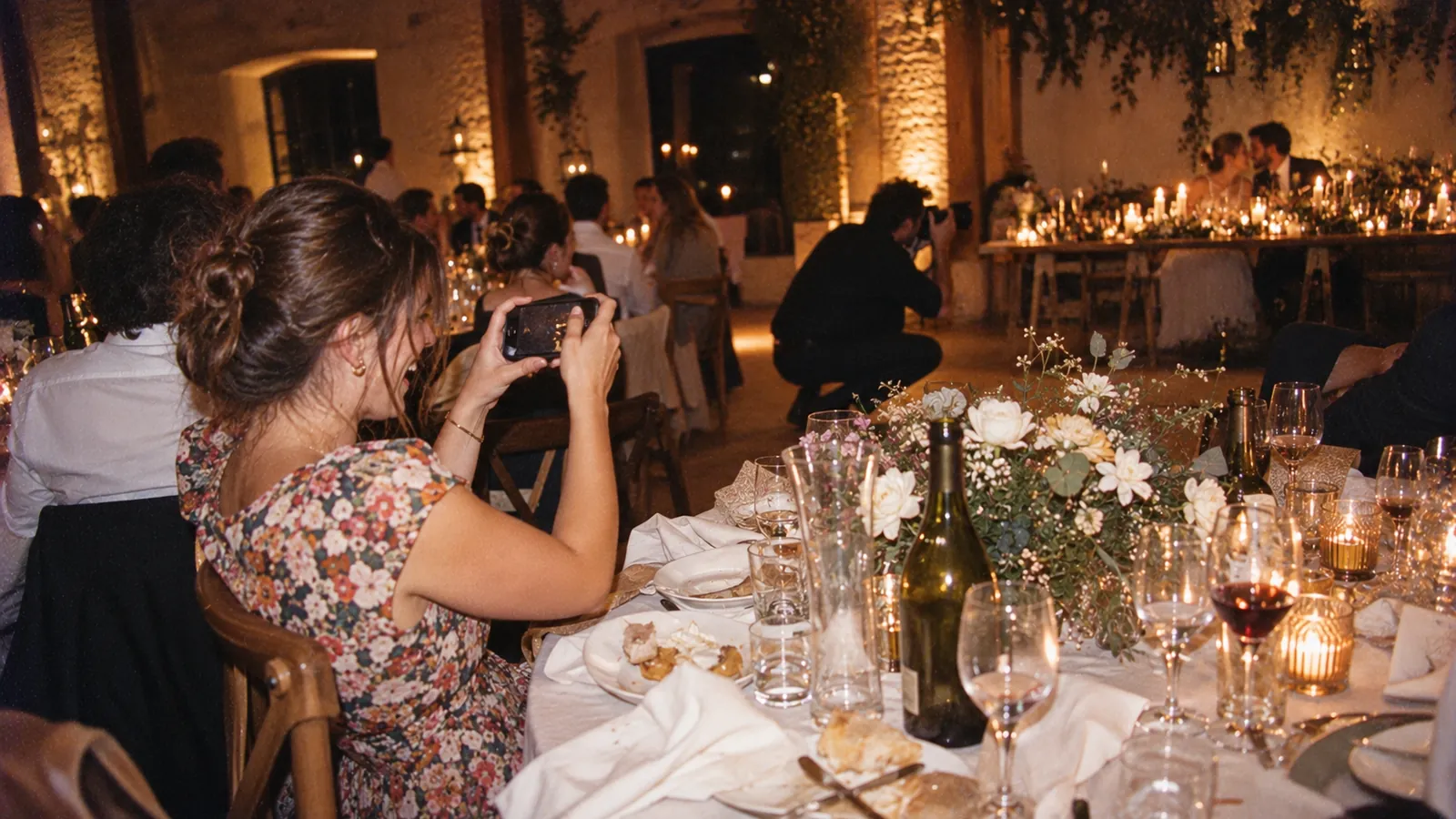
For the couple: the photos the photographer can’t take. They are with the couple during portraits; they don’t see the back table, the laughter at the bar, grandma on the dance floor at 1 a.m. The guests are everywhere.
There are several ways to do it: a photo booth, a guest book with an instant camera, a shared gallery, or a disposable camera activity on the guests’ phones. We compare them in photo booth, selfie booth, mirror or disposable: which to choose?
Take the disposable camera format, which is what we built with Time to Flash. Each guest scans a QR code, types their first name, and their phone becomes a disposable camera: no app to install, a limited number of shots (3 to 15, your choice), a film look, and photos hidden until the reveal. The next day, the album opens all at once for everyone.
What you handle, in practice:
- Setting up the event: shots per guest, when the reveal happens (the next day by default), the film look. You can invite the couple as co-organisers.
- The print kit: the QR code alone, an A4 poster, table tents and small cards come ready to print from the dashboard. You fold them into your signage.
- The announcement: one line in the DJ’s sheet or in the best man’s or maid of honour’s words during the drinks reception.
- Reviewing before the reveal, with the couple if you like: the organiser sees the photos before anyone else and can remove any that cause offence.
How long it takes you: in practice half an hour of preparation is enough (setup, printing, a line in the run of show), then a few minutes on the day to put up the posters. Nothing to assemble, no technician, no deposit.
Effort and margin: it is a one-off payment based on guest count, for example €34.99 for up to 150 guests or €59.99 for up to 300. You can include it in your packages as a signature touch, or offer it as an option.
How to sell it: show it. Have the couple scan the QR code during the meeting and take a photo. It is usually something they haven’t seen at other weddings, and it complements the photographer rather than competing with them.
9. Order of service and guest kits
For the couple: guests who know what is happening and when. The order of service, the weekend programme, and the little kits that save an evening (fans, tissues, blister plasters, dancing flip-flops).
Effort and margin: low, especially combined with stationery. The margin comes from bulk buying and assembly.
How to sell it: alongside another service, never alone. A basket of kits in the cloakroom is the kind of detail guests mention to the couple.
10. The whole weekend: the night before and the day-after brunch
For the couple: a two- or three-day wedding, increasingly common, without the logistics of the welcome dinner and brunch falling on them.
Effort and margin: it is often the same venue and the same vendors. A brunch takes far less energy to coordinate than the wedding day, which makes it one of the best ratios of time spent to revenue.
How to sell it: present the brunch as the end of the wedding, not as an extra meal. It is also the perfect moment to reveal the guests’ photos, which everyone discovers together (see the next-day reveal).
11. Supporting the wedding party, and the hen or stag do
For the couple: a wedding party who knows what is expected of them, and a hen or stag do that doesn’t spill into wedding week.
Effort and margin: a briefing meeting with the wedding party takes an hour. Organising a whole hen do is a real project, with a different client (the friends). Decide whether you want that market.
How to sell it: the wedding party briefing fits easily into every package. It saves you time on the day, and the wedding party become your allies (and often your future clients).
12. After the wedding
For the couple: nothing to deal with when they get back: rentals returned, tableware collected, thank-you cards, dress care, photos gathered in one place.
Effort and margin: low, and it extends the relationship past the wedding day. It is also the window when couples are most willing to leave a review and recommend you.
How to sell it: as an option at signing, or included in full planning. We come back to why this moment matters for your reputation in how to find wedding planning clients.
The summary table
| Service | Your effort | Possible margin | When to offer it |
|---|---|---|---|
| Design and styling | High | High | First meeting |
| Stationery | Medium | Good | After signing |
| Guest management | Medium | Medium | Six months out |
| Accommodation and transport | Medium | Low to medium | Once the venue is chosen |
| Legal paperwork help | Low | Low (selling point) | At signing |
| Symbolic ceremony | High if you officiate | Good | First meeting |
| Entertainment | Low to medium | Medium | Four to six months out |
| Guest photo activity | Very low | Up to you | First meeting (demo) |
| Order of service and kits | Low | Medium | With stationery |
| Weekend and brunch | Medium | Good | At signing |
| Wedding party and hen do | Low to high | Variable | Three to six months out |
| After the wedding | Low | Low (loyalty) | At signing |
How to present your add-ons
A list of twelve options at the bottom of a quote scares people off. Three approaches work better.
Bundles rather than a menu. Group services by logic: a “guests” bundle (guest management, accommodation, shuttles, kits), a “design” bundle (styling, stationery, order of service), a “weekend” bundle (welcome dinner, brunch, after the wedding). Couples choose a bundle, not ten lines.
A signature included everywhere. Pick one or two services that cost you little and are very visible to guests, and include them in every package. That is what makes guests ask “who organised this?”.
The right moment. At the first meeting, talk about what gets contracts signed (design, ceremony, a live demo). Logistics options (shuttles, kits, after the wedding) come later, when the couple starts to realise how much is left to do.
How to stand out as a wedding planner
Add-ons are not enough if they look like everyone else’s. Four levers make the difference.
- A clear specialty. Countryside weddings, small weddings, multicultural weddings, low-impact weddings: a precise positioning is easier to remember than “all kinds of weddings”.
- A visible method. Show your planning timeline, your run of show, your vendor sheet (there is a template in the hour-by-hour wedding day timeline). Couples are buying peace of mind: prove it.
- An experience for the guests. Couples don’t remember your spreadsheet; they remember what their guests told them. An activity that involves everyone, a thoughtful order of service, a shuttle on time: that is what gets talked about afterwards.
- Follow-up after the day. Most vendors vanish the next morning. A message on the morning the photos are revealed, some feedback on the evening, a review request at the right time: that is the best advertising you can get.
In short
- Scope your three core packages in writing (vendors included, number of meetings).
- Choose the add-ons that match your specialty, not all of them.
- Group them into bundles, and include a signature touch guests can see in every package.
- Stay in touch after the wedding: that is where referrals are born.
If a guest photo activity appeals to you as a service for your couples, we have opened a space for wedding professionals: offer Time to Flash to your couples. And to structure your business, see also the wedding planner’s toolkit for 2026.
Frequently asked questions
What services does a wedding planner offer?
Most planners offer three packages: full planning (from budget to the day), partial planning (some vendors plus coordination) and day-of coordination, which in practice starts one to three months before. Many add extra services such as design, stationery, guest management or accommodation.
What add-on services can a wedding planner offer?
The most common are design and styling, stationery, guest management, accommodation and shuttles, symbolic ceremonies, entertainment and guest photo activities, the day-after brunch and post-wedding services. The key is to pick the ones that fit your specialty and group them into bundles.
How much does day-of coordination cost?
In France in 2026, typical rates range from about €900 for a new planner to €2,500 for an experienced one, sometimes more at the high end. The price depends on the region, the guest count and how much preparation is included beforehand.
How can a wedding planner stand out?
By choosing a clear specialty, showing their method (planning timeline, run of show, vendor sheet), offering an experience guests talk about, and staying present after the wedding. A live demo in a meeting is more convincing than a list of services.
Can a wedding planner sell guest accommodation?
They can negotiate rates and coordinate bookings. Selling a bundle of transport and accommodation at a single price, however, may count as package travel, which in France requires registration with Atout France. Check the rules in your country before invoicing this kind of service.