Wedding day timeline: an hour-by-hour schedule template
A wedding day timeline from 9 a.m. to 4 a.m., its variations (winter, morning ceremony, brunch), the buffers to build in and the vendor sheet to send.
A good wedding day timeline is what lets you live your day instead of managing it. It is an hour-by-hour table, shared with every vendor, saying who does what, where and when, from morning make-up to the last shuttle.
Here is a complete template, from 9 a.m. to 4 a.m., based on a typical French wedding: a civil ceremony at the town hall, a symbolic or religious ceremony, a drinks reception, dinner and a party that runs late. If your wedding follows a different rhythm, the logic stays the same. Then come the variations (winter wedding, morning ceremony, next-day brunch), the buffers to plan, who should run the timeline, and the sheet to send to vendors. Wedding planners can use it as a starting framework too.
The wedding day timeline: where to start
A timeline is built backwards from three fixed points:
- The time of the legal ceremony, often set by the registry office or town hall. It is the least negotiable point of the day.
- Sunset, if you want couple portraits in golden light. In June, the sun sets around 10 p.m. in much of France; in October, around 7 p.m.
- The end time set by the venue (and the DJ’s contract), which fixes the end of the evening.
Between those points, you place the key moments, then add travel and buffers. This work happens a few weeks before the wedding: it is one of the last steps in your planning timeline.
The template: an hour-by-hour wedding schedule
Assumptions: a Saturday in June, 100 guests, town hall at 2 p.m., a symbolic (or religious) ceremony at 4 p.m. at or near the venue, then drinks, dinner and party at the same place.
| Time | What happens | Who is involved |
|---|---|---|
| 9:00 | Breakfast, hair and make-up begin (starting with family and friends; the couple goes last) | Couple, wedding party, hair and make-up |
| 9:30 | Planner or coordinator arrives at the venue, welcomes the florist and decorator | Coordinator, florist, venue |
| 10:30 | Bouquets and buttonholes delivered to both getting-ready locations | Florist, wedding party |
| 11:00 | Photographer arrives for getting ready (details, outfits, rings, atmosphere) | Photographer |
| 12:00 | Light lunch for everyone getting ready (nobody should reach the ceremony hungry) | Couple, family and friends |
| 12:45 | The couple gets dressed | Couple, wedding party, photographer |
| 13:15 | First look and a few portraits, if you want them | Couple, photographer |
| 13:30 | Departure for the town hall | Couple, driver |
| 13:40 | Guests gather outside the town hall | Guests, wedding party |
| 14:00 | Civil ceremony (often 20 to 30 minutes) | Couple, witnesses, registrar |
| 14:30 | Exit, confetti, group photo on the steps | Everyone, photographer |
| 15:00 | Travel to the symbolic ceremony (or the church) | Everyone |
| 15:30 | Guests take their seats, welcome music, orders of service handed out | Guests, coordinator, musicians |
| 16:00 | Symbolic or religious ceremony (45 minutes to 1 hour) | Couple, celebrant, speakers |
| 17:00 | Ceremony exit, drinks reception begins | Everyone, caterer |
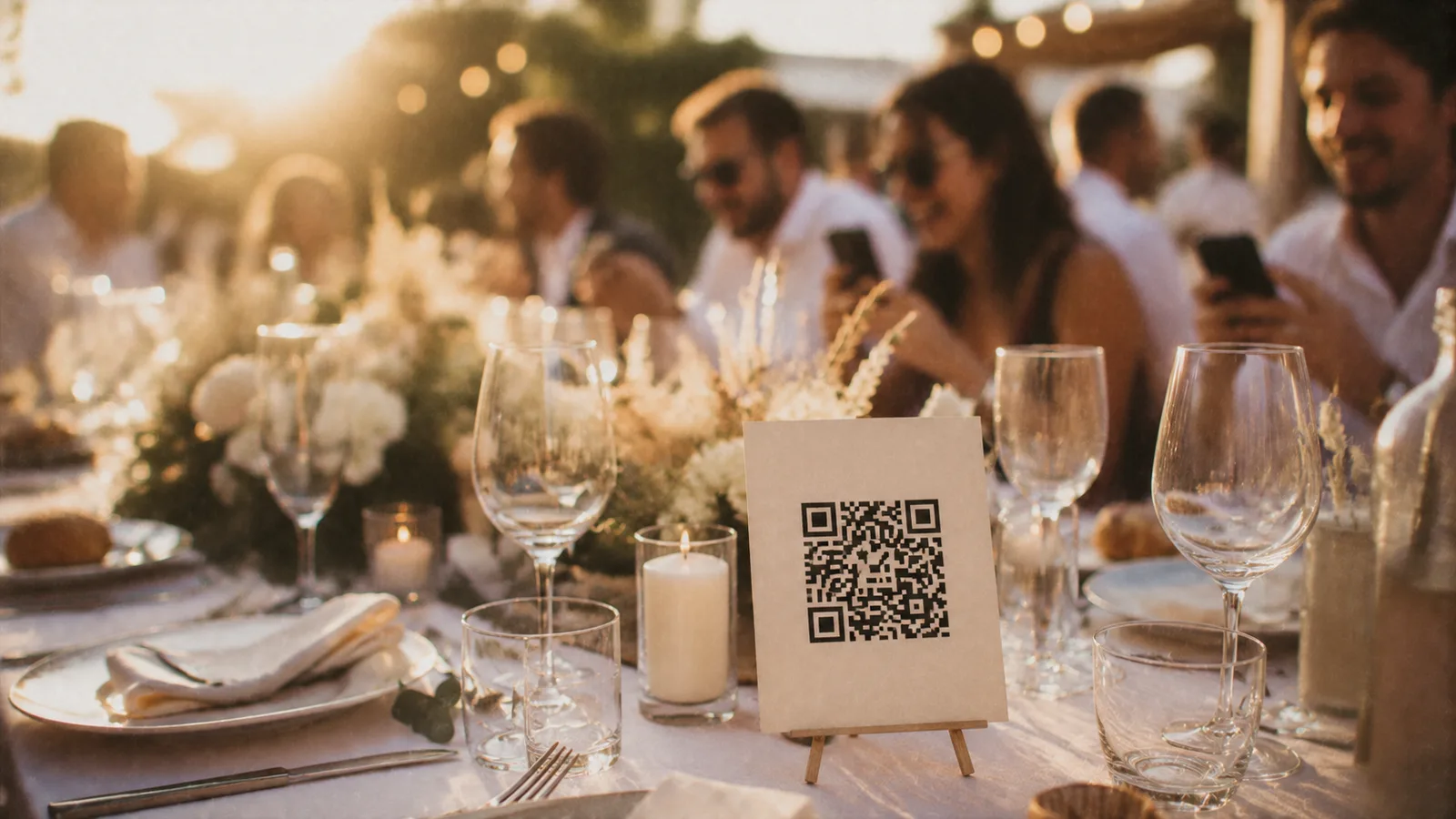
| 17:15 | QR code posters for the photo activity are in place (bar, high tables, entrance), and the DJ or the wedding party announce it on the mic | Coordinator, DJ or wedding party |
| 17:30 | Group photos (family, friends, colleagues), list prepared in advance | Photographer, a friend who calls the groups |
| 18:15 | The couple enjoys the drinks reception with their guests | Couple |
| 19:30 | Guests move to the dining room and find their table | Guests, coordinator, caterer |
| 19:50 | The couple’s entrance | Couple, DJ |
| 20:00 | Starter served | Caterer |
| 20:45 | First speeches (wedding party, parents), between courses | Wedding party, parents, DJ |
| 21:15 | Main course | Caterer |
| 21:30 | Fifteen minutes of couple portraits outside, in the sunset light | Couple, photographer |
| 22:15 | Cheese course, an activity or a video from friends | Caterer, wedding party |
| 23:00 | Dessert, croquembouche or cake | Caterer, DJ |
| 23:30 | First dance, dance floor opens | Couple, DJ |
| 00:00 | Party. The photographer often leaves between midnight and 1 a.m.: this is when guests’ photos take over | Everyone |
| 01:30 | Late-night snacks (onion soup is a French classic) | Caterer |
| 03:00 | Last songs, depending on the end time in the contract | DJ |
| 04:00 | Last shuttles, venue closes | Guests, venue, drivers |
| The next day | Brunch (for example 11 a.m. to 3 p.m.) and reveal of the guests’ photo album | Couple, family and friends |
This table is a base. Exact times depend on your registry office, the distance between venues and your caterer: ask them for the real service time of their menu, which is often what makes an evening slip.
Three moments not to miss
Announcing the photo activity at the drinks reception
The drinks reception is the best time to launch a photo activity: guests have their hands free, they are waiting for the couple, and the light is still good. If you use a QR code (a shared gallery or a disposable camera like Time to Flash), the posters must be in place when guests come out of the ceremony, and someone should announce it on the mic within the first fifteen minutes. A poster alone gets few scans. We explain where to put them in where to place the QR code, and you can create a poster for free with our QR code poster generator.
Group photos
This is the slot that overruns most often. Prepare a short list (ten groups at most), give it to the photographer and to a friend who knows both families and can call the groups. Details in how to get wedding group photos right.
The next-day album reveal
If your guests’ photos stay hidden until the next day, the reveal becomes a second highlight, ideally during brunch or late morning. Everyone discovers the evening through other people’s eyes, at the same time. It is explained in the next-day photo reveal.
Timeline variations
Winter wedding
In December, night falls around 5 p.m. in France. Bring forward everything that needs daylight: couple portraits before the ceremony (with a morning first look), group photos right after the ceremony, indoors if needed. The drinks reception happens somewhere warm, often shorter (an hour is enough), and dinner can start earlier, around 7 p.m. Plan a cloakroom and blankets for the journeys.
Morning ceremony
Ceremony around 11 a.m., drinks at noon, then a seated lunch around 1:30 p.m. The afternoon is for games, activities or free time, and the evening continues with a lighter dinner (buffet, food trucks) before the party. The upside: your guests enjoy the daylight. The downside: a very long day, so plan quiet moments, especially for children and older guests.
Legal ceremony the day before
More and more couples do the legal part on the Friday with close family, and keep Saturday for the symbolic ceremony and the party. Saturday’s timeline then starts later: getting ready at 11 a.m., symbolic ceremony at 4 p.m., and the rest unchanged.
Religious wedding
In France, the civil marriage must take place before the religious ceremony. Church times are set with the parish or officiant, sometimes months in advance. Allow about 45 minutes for a ceremony without Mass, and over an hour with one.
The next-day brunch
A wide time slot (11 a.m. to 3 p.m., for example) lets everyone arrive at their own pace. Plan a table or two for the most tired, space for children, and a moment to launch the reveal of the guests’ photos: everyone is there, phone in hand, to discover them together.
The night before and the morning: what must be ready
A timeline that holds on the day is prepared the night before. Before going to bed, check that these are sorted:
- Decor set up, or at least dropped off at the venue, with someone named to install it in the morning.
- The symbolic ceremony rehearsed with the speakers: who enters when, who reads what, where to stand.
- The rings handed to a member of the wedding party, not in the couple’s pocket.
- Envelopes for vendors to be paid on the day prepared and given to the coordinator, with a list.
- Posters and table signs (seating plan, photo QR code, signage) packed in a labelled box.
- An emergency kit: pins, sewing kit, tissues, plasters, painkillers, charger, stain remover.
- The timeline printed in several copies: coordinator, wedding party, caterer, DJ.
Children in the timeline
With lots of children, the template needs a few adjustments. Have their meal served earlier (around 7:30 p.m., while the adults finish their drinks), plan a childminder or a quiet corner with cushions and a film from 9 p.m., and tell parents when the youngest can go to bed if the venue has rooms. Children are also great photographers: with a QR code photo activity, they join in like the grown-ups, from a parent’s phone.
The wet-weather plan
A plan B can’t be improvised on the morning. Write into the timeline: the fallback location for the symbolic ceremony and drinks, who decides, and the decision deadline (often the night before or around 10 a.m., to give the venue and caterer time to reorganise). Bring umbrellas for leaving the town hall and for group photos too: clear umbrellas make lovely photos in the rain.
Buffers to build in
A timeline without buffers derails as soon as you leave the ceremony. These moments almost always take longer than planned:
| Moment | Planned time | Suggested buffer |
|---|---|---|
| Hair and make-up | 45 min per person | + 30 min overall |
| Travel between venues | Map app estimate | + 15 min (convoy, parking) |
| Leaving the ceremony | 15 min | + 15 min (everyone wants to congratulate you) |
| Group photos | 30 min | + 15 min |
| Moving from drinks to dinner | 15 min | + 15 min |
| Speeches | 3 to 5 min each | Limit the number rather than the length |
| Serving a course | Depends on the caterer | Ask for the real time |
A tip: don’t put all the buffers at the end. Place a small one after each risky moment, so a delay doesn’t ripple through the whole evening.
Who runs the timeline
Not you. On the day, you shouldn’t be looking at your watch. Three options:
- A wedding planner or day-of coordinator: it is their job; they know the vendors and anticipate delays.
- An organised friend or family member willing to spend part of the day with an eye on the clock. Choose someone without a heavy role already (speech, reading, activity).
- The DJ and the caterer’s head waiter, for the evening: they set the pace of dinner and speeches. They need the same timeline as everyone else.
Either way, one person makes the decisions when things go wrong (rain, a delay, a late course). Vendors need to know who that is.
The vendor sheet
The full timeline is for the person coordinating. Each vendor needs a one-page sheet with what concerns them. Send it two weeks before the wedding, then confirm by message in the week of the wedding.
What the sheet should include:
- Exact addresses (getting ready, town hall, ceremony, reception) and access (parking, delivery door, gate code).
- The coordinator’s contact, and a back-up contact.
- That vendor’s arrival, set-up and take-down times.
- The key moments that concern them (entrance, speeches, first dance, cake).
- The wet-weather plan.
- The meal planned for them, and when they can eat.
- For the photographer: the group photo list and the important people not to miss.
- For the DJ: music for key moments, the speech list, and the announcements to make (including the photo activity at the drinks reception).
For guests, an even shorter version is enough: times and addresses, on the wedding website or in a message. We have prepared the text to send them in the guest brief.
Classic mistakes
- Too many speeches. Beyond four or five, the room drifts off. Spread them between courses.
- Forgetting to eat. The couple is often in demand throughout dinner. Ask the caterer to serve you first, and protect that moment.
- A drinks reception without you. If group and couple photos take up the whole drinks reception, you don’t see your guests. Keep them short.
- No wet-weather plan. It must be written into the timeline, with the cut-off time for deciding.
- A timeline only the couple knows. If it isn’t shared with every vendor, it is useless.
In short
- Start from the fixed points (legal ceremony, sunset, end time) and work backwards.
- Put a buffer after each risky moment.
- Hand the timeline to someone other than you, and send a one-page sheet to each vendor two weeks before.
- Plan the photo activity announcement at the drinks reception, and the album reveal the next day.
For the photo activity, you can create your Time to Flash album (free for up to 5 guests, so you can try it with your wedding party). And if you are a wedding planner who wants to offer this activity to your couples, everything is in our space for wedding professionals.
Frequently asked questions
How do you build a wedding day timeline?
Start from the fixed points: the time of the legal ceremony, sunset if you want portraits in golden light, and the end time set by the venue. Then place the key moments (ceremony, drinks, dinner, first dance), add travel time and a buffer after each risky moment.
How long should the drinks reception last?
Usually between one and two and a half hours. It needs to leave time for group and couple photos while letting the couple enjoy their guests. In winter, an hour is often enough.
What time does a French wedding dinner start?
Most often around 8 p.m. for a wedding with an afternoon ceremony, after a drinks reception that starts around 5 p.m. In winter or with a morning ceremony, it can start earlier.
Who should run the timeline on the day?
A wedding planner or day-of coordinator, or failing that an organised friend who doesn’t already have a heavy role. The couple shouldn’t have to check the time, and vendors should know who makes the decisions if something unexpected happens.
When should you send the timeline to vendors?
About two weeks before the wedding, as a one-page sheet per vendor with addresses, contacts, their times and the moments that concern them. Then confirm by message in the week of the wedding.
When should you announce the guest photo activity?
At the start of the drinks reception, within the first fifteen minutes: guests have their hands free and are waiting for the couple. The QR code posters should be in place as guests leave the ceremony, and the DJ or wedding party announce it on the mic.